
Table of Contents
INTRO
When Nick and I got engaged in 2020, we landed on a notion: Our closest family and friends live all around the world. The opportunity to gather everyone that we care about for a weekend, in the same place, will rarely come again, if ever, and we need to maximize the opportunity. I spent a year and a half pondering how best to bring our loved ones together. In doing so, I arrived at many conclusions about gatherings in general.
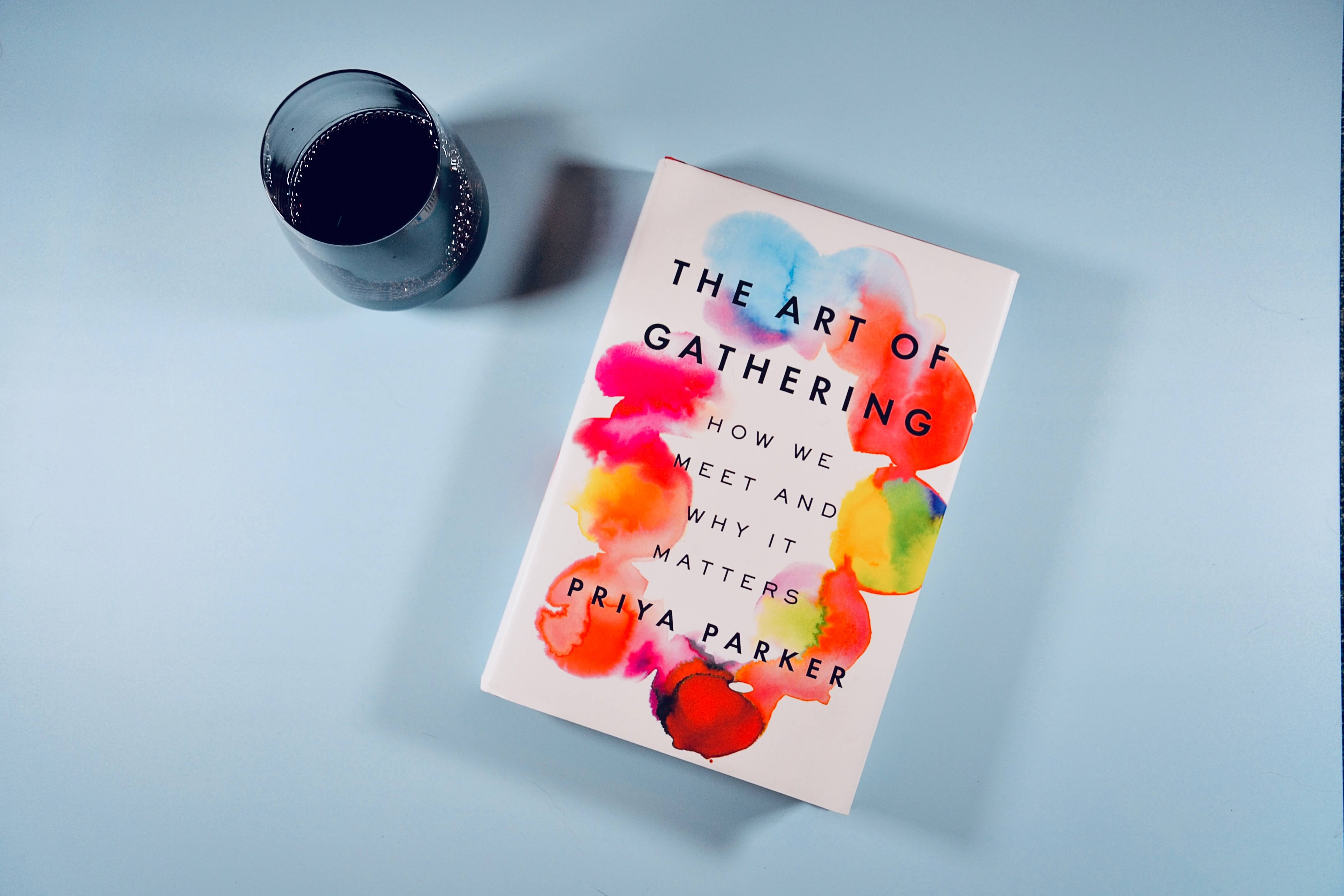
Fast forward to after our wedding, when I started reading Priya Parker’s “The Art of Gathering.” Priya describes how to create meaningful gatherings and why doing such is crucial to us as humans. While the conclusions that I drew from wedding planning aligned with Priya’s overall messaging, reading her book earlier would have been an assurance that I craved.
BUT, I’ve read it now and have Priya’s frameworks to give me assurance when planning meaningful work meetings, dinner parties, group vacations, etc. You should read this book, but if you do not, below are my main takeaways.
THE WHY BEHIND THIS BOOK
Early in the book, Priya writes a few compelling statements to help us understand that there is, in fact, a problem with the way in which we gather. “Any number of studies support a notion that’s obvious to us: Much of the time we spend in gatherings with other people disappoints us… The 2015 State of Enterprise Work survey found that “wasteful meetings” were employees’ top obstacle to getting work done… We don’t even seem to be thrilled with the time we spend with our friends. A 2013 study, The State of Friendship in America 2013: A Crisis of Confidence, found that 75% of respondents were unsatisfied with those relationships (friendships).”
But, we are meant to gather. Priya writes, “We gather to solve problems we can’t solve on our own. We gather to celebrate, to mourn, and to mark transitions. We gather to make decisions. We gather because we need one another…” the list goes on and on. Priya doesn’t distantly write this, but socialization, i.e., gathering, has been linked to notable long-term health benefits.
THE APPLICABLE TAKEAWAYS
TAKEAWAY #1: GATHERINGS, OF ANY SORT, MUST HAVE A GOAL/PURPOSE
Priya first explains that a gathering must have a goal/purpose. The purpose should have three qualities: 1) it should be specific, 2) it should be unique, and 3) it should be disputable, i.e., something that people could do in an alternative way. If you think you have a goal/purpose, ask yourself if you can take it one step further. Here are some examples of “good” purpose statements:
If a gathering is for a back-to-school night, a meaningful purpose would be “to inspire parents to sustain on evenings and weekends the values the school teaches during the days, and to help connect the parents to one another so as to make them a tribe.”
If a gathering is for a family reunion following a Grandpa’s death, a meaningful purpose would be “to convene the next generation in the wake of Grandpa’s death and create a more tolerant family reunion in line with the younger relatives’ values.” To reinforce bonds amongst grandchildren without the influence of outside family members.
While planning, I thought deeply about the purpose of our wedding. I tried to navigate decision making by anchoring in our purpose, which was “to create a guest-centric, food and nature driven weekend that maximized time with loved ones in an authentic, intentional way. To foster a feeling of warmth and connectivity amongst our closest family and friends, while honoring and celebrating what shaped us and our relationship. ”
**I did not explicitly think about our wedding’s purpose until ~6ish months into planning. Had I read Priya’s book sooner, I would have written a purpose statement immediately. The purpose statement helps one to anchor in a vision, which makes it SO much easier to make decisions for any type of gathering.


Images By: Jake Anderson Photography
TAKEAWAY #2: A THOUGHTFUL GUEST LIST IS CRUCIAL TO ACHIEVING THE GATHERING’S PURPOSE
Priya says that there can be kindness in exclusion as she describes a story.
Priya was part of a workout group of six friends that gathered twice a week at a park with a trainer and exercised while catching up. One friend was going on vacation and didn’t want to lose money from missing a class, so she asked someone not in the group to fill in for her while she was gone. The other friends were “surprised with the substitution, but couldn’t articulate why.” Eventually, the women realized that the workouts were not just for the sake of working out. “The undiscussed but shared understanding of [their] gathering was to spend time as friends while exercising. It was a hangout that used the convening mechanism of exercise, not an exercise class that happened to be attended by friends. [They] were a group of people with busy lives who wanted to find a regular, reliable way of reconnecting with specific other people THEY had chosen.”
Strangers, like it or not, can damage the intimacy of a group setting, as people are less willing to share with others that they don’t know. Had the objective of the group been different, a different guest list might have been ok. Priya mentioned a snippet of wisdom that Barak Obama’s aunt told him. “If everyone is family, no one is family... It is blood that makes a tribe, a border that makes a nation. The same is true of gatherings. So here is a corollary to his aunt’s saying: If everyone is invited, no one is invited – in the sense of being truly held by the group. By closing the door, you create a room.”
It is ok to be exclusive if it supports your purpose, because being exclusive can make a more inclusive gathering for those invited. Priya gives another example of how a group of her friends, in their younger years, had a tradition of going out of town together. A member of the friend group wanted to add others to the tradition, but the consensus was to not, because a friend within the group had not come out as gay and used the trip as a time to be his most free/authentic self. Adding others, who this person did not know, could impact the space’s allowance for authenticity.
It’s hard to exclude. Priya says that a host must “shift [their] perception so that [they] understand that people who aren’t fulfilling the purpose of the gathering are detracting from it, even if they DO nothing to detract from it.” Once someone is present, we, as accommodating humans, attempt to make them feel comfortable. Doing such, takes away from the gathering’s true purpose and the experience for the other guests.
“Excluding well and purposefully is reframing who and what you are being generous to- your guests and your purpose.”
TAKEAWAY #3: PICKING A VENUE IS ALSO IMPORTANT TO ACHIEVING THE PURPOSE
“You should seek a setting that embodies the reason for your convening. When a place embodies an idea, it brings a person’s body and whole being into the experience, not only their minds.” The venue should inspire the behaviors that you want from your guests and, perhaps most importantly, displace people. It should “break people of their daily habits.” Such can be done in creative ways and not necessarily fancy ways.
Priya gives an example of how the CEO of Gentle Giant moving Company, based in Boston, takes new employees on a run through the city, as their orientation. The race ends at the steps of Harvard Stadium. The purpose of the orientation is to show employees that to work there they “have to be physically fit, and just as important, when [they] are doing hard work, they should do it collegially, cooperatively, cheerfully, and with a sense of sport.” The venue, Harvard Stadium, aids in fulfilling that purpose.
TAKEAWAY #4: DON’T BE A “CHILL” HOST. EXERCISE GENEROUS AUTHORITY
Priya writes “Behind the ethic of chill hosting lies a simple fallacy: Hosts assume that leaving guests alone means that the guests will be left alone, when in fact they will be left to one another… What they fail to realize is that this pulling back far from pouring a fathering of power, creates a vacuum that others can fill. Those others are likely to exercise power in a manner inconsistent with your gathering’s purpose, and exercise it over people who signed up to be at your- the host’s- mercery, but definitely didn’t sign up to be at the mercy of your drunk uncle.”
If you do not steer the direction of the night, someone else might. One with generous authority acts in a way that protects, equalizes, and connects the guests of the gathering. Think of this as a utilitarian way of serving. Authority can be bad if it is not generous authority, e.g., one that hosts with a rigidity that doesn’t serve the guests.
TAKEAWAY #5: ESTABLISHING AND MAKING GUESTS AWARE OF RULES BEFOREHAND IS BENEFICIAL
And these rules do not necessarily include random ways that “old rich people want you to behave.” Etiquette can make it more difficult to gather across differences. Rules can create standards and structure that make it easier for others to gather across differences. An example of a rule is requiring guests at a party to pour drinks for each other, but not themselves to promote increased mingling and no-pressure ice breakers.
When Priya and her husband first moved to NYC, they started “I am here” days to explore their new home. Others became interested in being part of “I am here” days and so Priya set rules to achieve the gathering’s purpose and notes that two of these rules were crucial. 1) If others joined, they had to be there for the entire day. Once they knew that they were stuck, “they became more relaxed. They couldn’t micro-coordinate. They were giving up the option of finding a better option. They were just [there]. And because [they] were all there, [they] enjoyed one another’s company to the fullest.” 2) No technology was allowed, which also aided in people being more present.
TAKEAWAY #6: PREPARING/PRIMING GUESTS AHEAD OF TIME AND HONORING GUESTS UPON ARRIVAL WILL MARK A DISTINCT START TO THE GATHERING
People will form preconceived notions about your gathering before it happens. Create an impression that makes those notions positive and excites guests. Priya gives an example of a professor who memorizes the names of all of his students based on their pictures from a student directory before the first day of class. He honors the students by taking attendence from memory and the students feel welcomed and engaged.
Set the table, even if it’s for, in Priya’s case, your friend who comes over all the time and might as well be family, it will make 1) the guest(s) feel honored and 2) the gathering feel special.
TAKEAWAY #7: AUTHENTICITY CAN BE DESIGNED
Priya wanted to create an intimate sideline dinner for the World Economic Forum, “an organization that convenes the world’s rich and powerful several times a year.” She wanted to find out if she could create an environment where powerful, always well presented, people could be vulnerable, raw and truly connect. So she invited 15-guests and chose a theme, “A Good Life.” Upon arrival, she asked each guest to volunteer to give a toast to “a good life.” She implemented a rule: the last guests to toast had to sing their toast. (The guest didn’t know about the toasts ahead of time). Priya requested that the toasts begin with a personal story. She was successful in her goal: people shared their true selves (not the polished, successful versions), and consequently, laughed and cried together in a way that fostered authentic connection.
The dinner, and toasts, were so successful, that Priya hosted similar “dinner parties” across the world, with fantastic results. She calls these dinners “15 Toasts.”
To get raw authenticity, a few things must be true: Setting the right environment (these dinners were held in privates spaces, with low lighting, flickering candles, comforting food, and flowing wine), is important. Personal stories should be encouraged. Stories help us connect to one another, and we should remember that raw, authentic conversations will take dark turns. It’s ok to talk about things that we don’t usually discuss, e.g., death.
Our family and friends can naturally bring an “expert attitude” to our life stories. E.g., A friend might say “I believe you to be x, I know you don’t like doing y, etc.” Thus, we often feel comfortable sharing with strangers because, “with strangers, there is a temporary reordering of a balancing act that each of us is constantly attempting: between our past selves and our future selves…” Our family and friends already know who we’ve been and make assumptions about who we’ll become.
See those you know with fresh eyes: when guests share stories that even their closest loved ones don’t know, we see each other in new lights, which deepens connection. Don’t imprint your preconceived notions about your loved ones onto their stories.
As a host, be explicit with your expectations for the gathering. Priya explains that when she hosts 15 Toasts “as a sideline to a business conference or an-other high powered gathering, [she] tend[s] to say in [her] welcome words that there is a typical dynamic to such events that [they’re] hoping to avoid- the dynamic of showiness and puffery.” Priya “invites people to leave outside the door those parts of their lives and work that are going great. We’re interested in the half-baked parts.”Priya writes that with families, she encourages them to “leave their familiar stories about themselves at the door and bring into the room the parts of themselves that might surprise even their kids.”
As a host, show what you want by doing, not telling. Share your own uncomfortably vulnerable story. As a host, you also should mitigate the risk of sharing by being “attentive to the needs of different personalities.”
TAKEAWAY #8: DESPITE WHAT SOCIETY TELLS US, CONTROVERSY IS OK
We do not grow from easy conversations. Despite this, society (and etiquette) have long held that we should not talk about “sex, politics, and religion” at gatherings. In fact, we should not talk about anything that makes others uncomfortable. But, gatherings with spice can be invigorating and purposeful.
“Good controversy,” according to Priya ” is the kind of contention that helps people look more closely at what they care about, when there is danger but also real benefit in doing so…. Good controversy helps us re-examine what we hold dear: our values, priorities, nonnegotiable… It helps communities move forward with their thinking. It helps us grow. “ To touch areas of heat, i.e., “stuff” that people hold strong feelings around, Priya says that “you need to know where they are. Thus you make a heat map. You can do this by asking your self (and others) the following questions: What are people avoiding that they don’t think they’re avoiding? What are the sacred cows here? What goes unsaid? What are we trying to protect? And why?” Touching the areas of heat, while maintaining a “safe space” is difficult, yet crucial.
Setting ground rules can help with creating a safe space for “debate.” Asking guests to outline their boundaries for a safe conversation is also important.
TAKEAWAY #9: GATHERINGS WILL END
We, as hosts, often forget to have a closing, we typically let the event “fizzle” out. But a good closing, should leave guests to “fall back into their own skin,” as they soak in all that they’ve experienced from the gathering. Priya writes, “the first step to closing a gathering well is less practical than it is spiritual or metaphysical: You must, before anything, accept tat there is an end. You must accept your gathering’s mortality.”
Every gathering has an awkward moment where it sits at the crossroads of “prolonging” and ending. Determine who should make the decision to issue the “last call.” Finally, “A strong closing has two phases, corresponding to two distinct needs among your guests: looking inward and turning outward. Looking inward is about taking a moment to understand, remember, acknowledge, and reflect on what just transpired- and to bond as a group one last time. Turning outward is about preparing to part from one another and retake your place in the world.”